
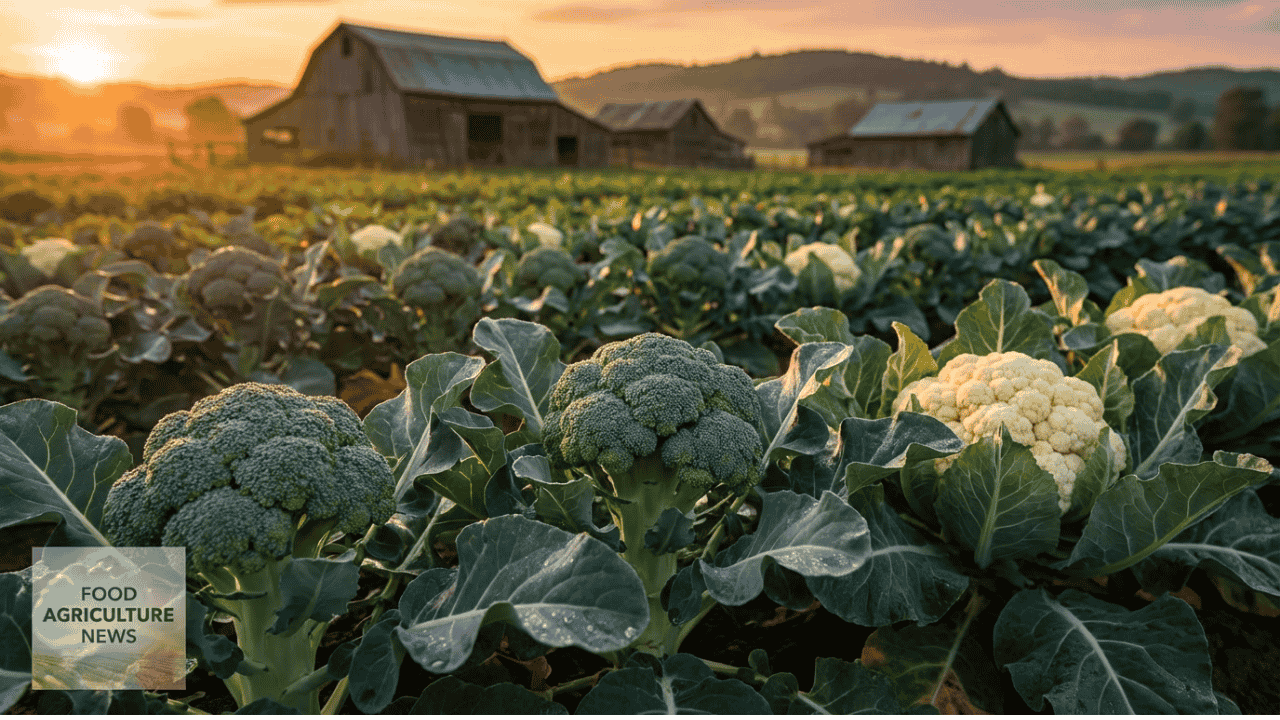
Most people see cauliflower, broccoli, and cabbage as completely different vegetables — each with its own personality in the kitchen. But botanically speaking, they’re all siblings. Not cousins, not distant relatives — siblings. Every floret and leaf traces back to a single species that humans quietly sculpted over centuries: Brassica oleracea.
What looks like diversity is actually one of the most astonishing examples of selective cultivation in human history.
One Plant, Many Faces

Cauliflower, broccoli, cabbage, kale, and Brussels sprouts all share the same genetic foundation. Their ancestor was a scrappy little plant that clung to rocky coastal cliffs along the Mediterranean and Atlantic shores of Europe — hardy, salt-tolerant, and frankly unimpressive to look at.
Then people started paying attention.
Early farmers noticed the odd standout plant — maybe one with thicker stems, curlier leaves, or a more compact head. Instead of eating everything, they saved seeds from the best performers. Slowly, generation by generation, human taste became a driving force of evolution.

The result? The same wild plant reinvented itself in half a dozen forms.
| Vegetable | Selected Trait | Edible Focus |
|---|---|---|
| Cabbage | Tightly packed inner leaves | Leaf head |
| Kale | Open, curly outer leaves | Leaf blades |
| Broccoli | Branching flower clusters | Flower buds & stems |
| Cauliflower | Dense, pale flower head | Immature flower buds |
| Brussels sprouts | Compact side buds | Axillary leaf buds |
Each vegetable is a different expression of the same genome, shaped by centuries of human curiosity.
The Mediterranean Origin Story
Historical records trace early Brassica oleracea cultivation back to ancient Greek and Egyptian societies. They mostly ate it as leafy greens, similar to modern kale. By the 3rd century BCE, Italian farmers were already domesticating and refining it.

Through the Middle Ages, kale-type varieties dominated Europe’s fields. They were cold-hardy, nutrient-rich, and survived where other vegetables failed. Then came the Italian horticultural boom — growers around the 15th century began selectively breeding for edible flower buds, leading to the birth of broccoli and cauliflower.
By the time modern agriculture emerged, these offshoots had become distinct foods in trade, cuisine, and even cultural identity — even though, under the microscope, their DNA still told the same story.
How Each Form Evolved
The transformation of Brassica oleracea is almost a case study in evolutionary flexibility guided by human hands.
- Broccoli was bred for its green flower clusters — open, branching, and vibrant, with each stem topped by tiny unopened buds.
- Cauliflower, by contrast, was selected for the opposite trait: dense, compact buds that stay pale because the surrounding leaves shield them from sunlight.
- Cabbage went underground, so to speak. Farmers selected plants with tightly curling inner leaves, creating the compact heads we recognize today.
- Kale remained loose-leaved and open, more faithful to the wild form.
- Brussels sprouts, the latecomer, were engineered by selecting side buds along the stem — a botanical feat of miniature cabbage design.
It’s agriculture as slow-motion sculpture.
Shared Roots, Shared Needs
Since all these vegetables are genetically related, they thrive in similar conditions: cool weather, rich soil, and consistent moisture. They’re also vulnerable to the same diseases, which is why gardeners rotate crops — planting brassicas in different beds each year to prevent soil-borne issues like clubroot.
Some varieties, like ornamental kale, exist purely for beauty. Their vivid purples and blues are the peacocks of the Brassica world.
Nutrition in a Compact Package
Cauliflower often gets overshadowed by its green cousin broccoli, but nutritionally, it’s a quiet powerhouse. According to the U.S. Department of Agriculture, one cup of raw cauliflower contains about 77% of your daily vitamin C, plus high levels of vitamin K, folate (B9), and fiber — all for roughly 25 calories.
| Nutrient | Primary Benefits |
|---|---|
| Vitamin C | Boosts immunity and aids iron absorption |
| Vitamin K | Supports bone health and blood clotting |
| Folate (B9) | Crucial for cell growth, especially in pregnancy |
| Fiber | Promotes digestion and gut health |
| Glucosinolates | Plant compounds linked to anti-inflammatory effects |
Those glucosinolates — the sulfur-rich compounds behind the pungent aroma of cooked cabbage or broccoli — are also believed to help protect cells from oxidative stress.
Culinary Versatility
Another reason the Brassica clan remains globally beloved? Versatility.
Cauliflower can be steamed, roasted, mashed, or even blitzed into a creamy soup. It’s become a darling of the low-carb movement, transforming into “rice,” “pizza crust,” or “steak.” Broccoli brings structure to stir-fries and salads, while cabbage underpins everything from kimchi to coleslaw to stuffed rolls. Kale, once livestock fodder, now headlines smoothie menus.
And Brussels sprouts? They’ve made a comeback — especially when roasted until crisp and caramelized, far removed from the boiled versions that scarred childhoods everywhere.
A Living Example of Human Influence
When viewed together, cauliflower, broccoli, cabbage, kale, and Brussels sprouts stop looking like separate species and start to resemble different dialects of the same language. Each represents a human decision repeated across centuries — what to plant, what to save, what to pass down.
The diversity we see on grocery shelves isn’t nature’s doing alone. It’s a record of collaboration between humans and plants — a slow, deliberate conversation that turned a rugged wild green into a global family of foods.
From wind-battered cliffs to kitchen counters, Brassica oleracea tells a story not just of agriculture, but of human patience and imagination.
FAQs
Are cauliflower, broccoli, and cabbage really the same species?
Yes. All belong to Brassica oleracea, a single species diversified through selective breeding over centuries.
How did they become so different in appearance?
Farmers selected for distinct traits — leaves, buds, stems, or flowers — gradually amplifying small natural variations until entirely new vegetables emerged.
Which part of cauliflower do we eat?
The compact, undeveloped flower buds known as the “curd.” They stay white because outer leaves block sunlight.
Are these vegetables equally nutritious?
Each has unique nutrient strengths, but all are rich in fiber, vitamins C and K, and beneficial plant compounds like glucosinolates.
Can they be grown together?
They can, but it’s risky. Since they share soil needs and pests, rotating them across seasons helps prevent disease buildup.