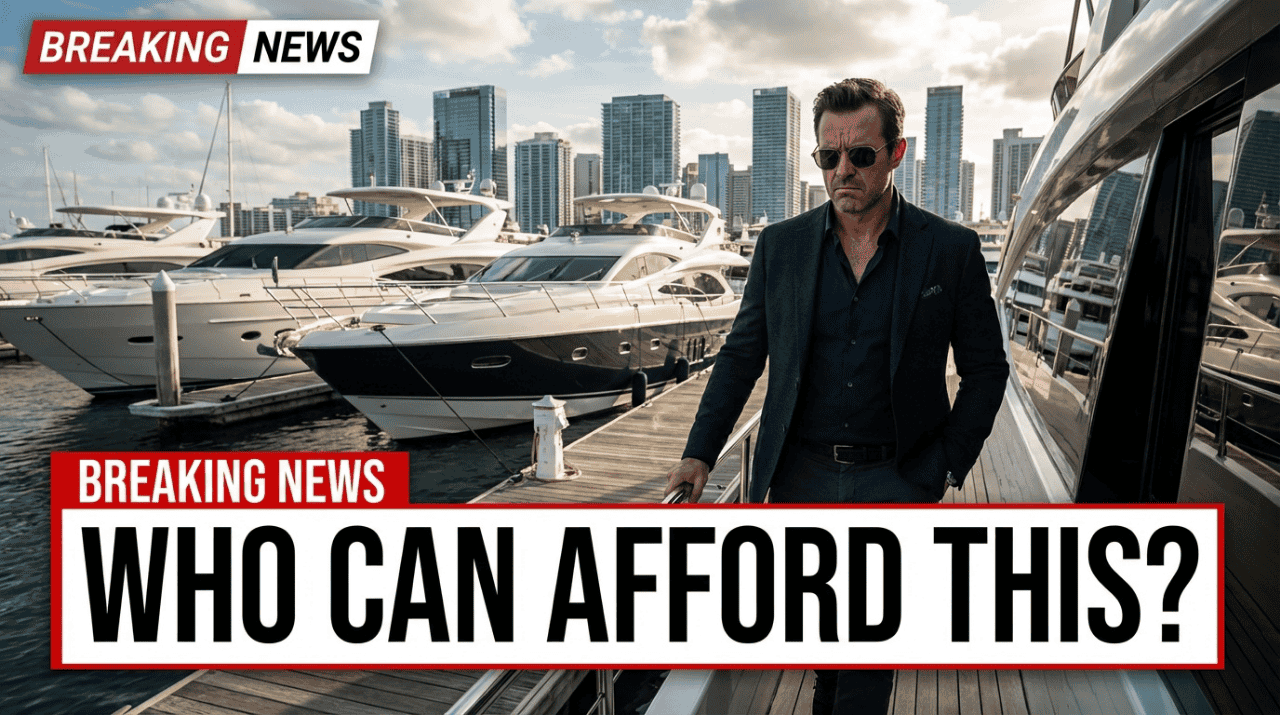
The yacht barely moved, yet you could hear it breathing — a low, mechanical sigh over Monaco’s glittering bay. Crew members in spotless polos polished railings already shining under the Mediterranean sun. Below deck, diesel generators throbbed nonstop, not to propel the vessel, but simply to keep it alive: lights glowing, marble bathrooms chilled, champagne at serving temperature.
The owner? He visited only a handful of times over three years.

Yet the yacht — a 90-meter, nine-figure floating palace — burned tons of diesel fuel simply to stay “ready.” Ready for what, exactly? A single night’s whim.
When Luxury Idles, the Planet Pays
Moored for three years, this yacht’s engines barely turned over. But its hotel-load systems — the air conditioning, pool filters, climate control, satellite communications — drew power as if it were hosting a permanent party.
Marine engineers call this “standby mode.” In practice, it’s a carbon-burning loop that never ends. A typical 80–100-meter yacht consumes 500–800 liters of diesel per hour when stationary to run auxiliary generators, according to the International Maritime Organization (IMO). Multiply that by 24 hours, by 365 days, by three years — and you’re staring at 3,000 to 5,000 tons of CO₂ quietly poured into the atmosphere for a ship that barely left the dock.

That’s roughly equal to the annual emissions of 700 average Europeans, based on European Environment Agency data.
And all for the comfort of one person.
| Yacht Size | Annual Idle Fuel Use | CO₂ Emissions (Approx.) | Equivalent Car Emissions |
|---|---|---|---|
| 90 meters | 1.8–2.5 million liters | 3,000–5,000 tons | ~700 cars/year |
| 50 meters | 900,000 liters | 1,500–2,000 tons | ~300 cars/year |
| 30 meters | 400,000 liters | 700–900 tons | ~150 cars/year |
Source: IMO, EEA, Superyacht Eco Association data (2025)
The Culture of “Always On”

Ask any captain why the engines never rest and you’ll get the same answer: status hates silence.
A yacht that looks “asleep” risks appearing neglected. One that glows at night, with crew in motion and the AC humming, tells the marina a different story — that its billionaire owner could board at any moment.
“You’re basically running a small town on diesel,” said a former superyacht engineer, speaking under condition of anonymity. “Even when no one’s on board, the systems don’t stop. You’re cooling the empty bedrooms, filtering pool water, powering the wine cellar, feeding crew quarters — it never ends.”
Shutting a yacht down completely is possible, but costly. Idle systems invite humidity, corrosion, and electrical faults. Restarting a “cold” ship can take days and tens of thousands of dollars. Prestige demands immediacy — and immediacy burns fuel.
The Billionaire’s Climate Bubble
What’s striking is the psychological distance between cause and consequence. From the quay, a lit-up yacht is beautiful — glass reflections, soft music, a flag fluttering. But beneath that serenity, the noise of exhaust and the smell of diesel linger.
Each ton of fuel burned becomes an invisible subsidy for comfort. It’s the ultimate climate bubble — a private microclimate built around one person’s convenience, floating in a warming world where nearby cities face water restrictions and deadly heatwaves.
And yet, we all understand the impulse on some level. We’ve all run the AC instead of opening a window, driven a short distance rather than walked, left a light on “just in case.” The yacht just scales that behavior to obscene proportions.
Quiet Efforts to Clean Up
Not all owners are blind to the optics. A new generation of shipyards — Feadship, Lürssen, Benetti — are racing to build hybrid or fully electric propulsion systems. Some new yachts feature solar-panel decks, lithium battery banks, and hydrogen fuel cells that allow several hours of “silent mode” at anchor.
Marinas in Amsterdam, Monaco, and Barcelona are upgrading to renewable shore-power grids that can support these floating hotels without firing up their generators. The European Commission’s Green Ports initiative aims to make shore-side electricity mandatory for large vessels by 2030.
Still, the challenge is cultural as much as technical. “Permanent readiness” — the expectation that every system must run 24/7 — is baked into yachting psychology. As one captain put it, “Turning things off feels like failure.”
What Real Change Could Look Like
Marine engineers suggest treating superyachts less like cars and more like smart buildings. That means segmenting systems — cooling only occupied cabins, shutting down full kitchens when no guests are aboard, using one generator instead of three.
These tweaks may sound minor, but over months, they can cut diesel use by 20–30% without changing the onboard experience.
Some environmental consultants have even started to rate yachts by “standby efficiency,” ranking them by how little fuel they burn while moored. It’s not exactly popular among owners — but it’s a start.
And as battery storage and shore power improve, that Monaco yacht humming endlessly through the night could soon become an embarrassing relic. The technology to fix the problem already exists. What’s missing is the social permission to let luxury rest.
The Larger Mirror
The moored superyacht isn’t just an isolated act of extravagance — it’s a reflection of a broader culture that equates comfort with virtue. The same logic fuels sprawling air-conditioned mansions, private jets idling on tarmacs, and fleets of SUVs making five-minute school runs.
But change often starts with small, symbolic gestures. Maybe it begins when one owner steps aboard, feels the cabin a few degrees warmer, and decides it’s fine.
Because at the end of the day, the superyacht idling for three years wasn’t a malfunction. It was the system functioning exactly as designed — an economy built to keep a few people endlessly cool, no matter how hot the world gets.
FAQs
Why can’t superyachts just plug into the grid while docked?
Many marinas lack sufficient shore-power capacity to feed large vessels. Even when available, much of that power still comes from fossil-fuel electricity.
Are hybrid or electric yachts common?
They’re growing in number but remain rare. New builds with full hybrid systems represent less than 10% of launches since 2023.
How much does it cost to keep a yacht “on standby”?
Operating costs can exceed $2–3 million per year in fuel, maintenance, and crew salaries, even without leaving port.
Can owners offset their yacht emissions?
Some do through carbon credits or sustainable marine programs, but offsets don’t reduce the underlying energy waste.
What’s the most effective change right now?
Better shore-power connections, reduced hotel loads, and time-based energy zoning onboard — all simple, existing solutions.